
-
About UsProductsCustomized SolutionProjectGalleryNews
News
How Woven Metal Fabric Is Changing Modern Interior Design
Release time: August 27, 2026Modern interior design is moving beyond traditional materials such as wood, glass, stone, and fabric. Architects and interior designers are increasingly looking for materials that can create texture, transparency, movement, light effects, and a distinctive visual identity.
Woven metal fabric is one of the materials attracting growing attention.
Made by interweaving metal wires into flexible mesh structures, woven metal fabric combines the visual qualities of textiles with the strength and durability of metal. It can be used for room dividers, wall decoration, ceilings, elevator interiors, stairways, reception areas, hotel interiors, restaurants, retail stores, and exhibition spaces.
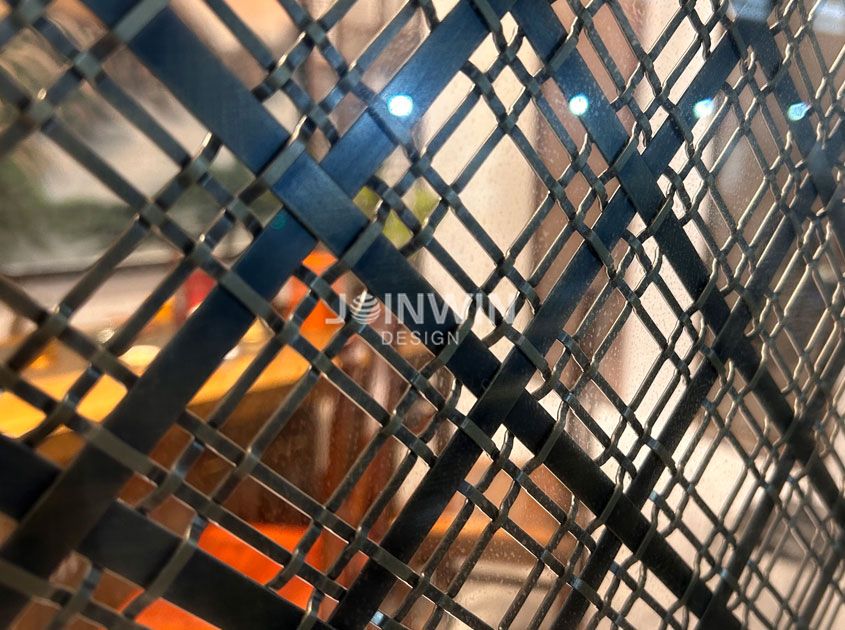
More importantly, woven metal fabric is changing how designers think about interior surfaces. Instead of treating a wall, partition, or ceiling as a solid boundary, designers can use metal fabric to create layers, transparency, shadows, reflections, and movement.
What Is Woven Metal Fabric?
Woven metal fabric is a flexible architectural material manufactured by weaving metal wires together according to different patterns.
Common materials include:
Stainless steel
Aluminum
Brass
Copper
Bronze
Depending on the material and weaving method, woven metal fabric can have very different appearances.
Some designs resemble traditional textiles, while others create highly technical or geometric patterns.
Unlike solid metal panels, woven metal fabric has open areas between the wires.
This gives it a unique combination of:
Metal strength + Textile flexibility + Architectural transparency
Why Is Woven Metal Fabric Becoming Popular?
There is no single reason for its growing popularity.
Instead, several characteristics make it particularly suitable for contemporary interiors.
1. It Adds Texture to Interior Spaces
Traditional flat surfaces can sometimes make an interior look visually uniform.
Woven metal fabric introduces another layer of texture.
The wires create:
Lines
Patterns
Shadows
Reflections
Depth
Under natural or artificial lighting, the mesh can change its appearance throughout the day.
This makes the material especially attractive for feature areas.
2. It Creates Transparency Without Losing Separation
One of the most important advantages of woven metal fabric is its ability to divide a space without completely closing it.
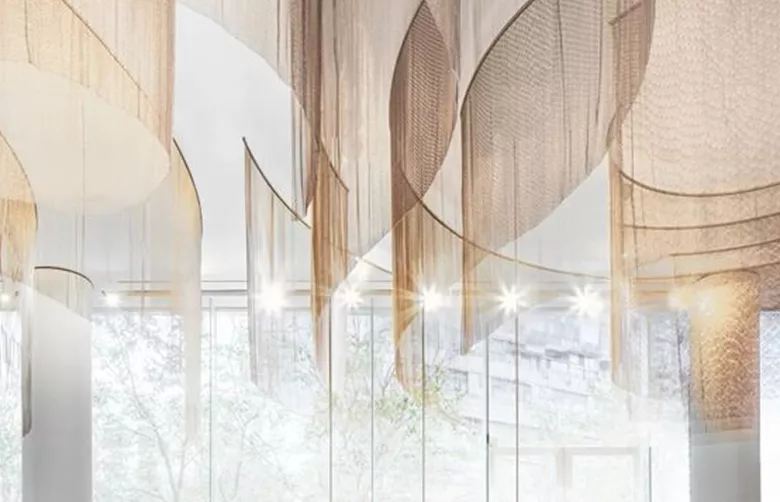
For example, a large hotel lobby can be divided into different functional areas using a metal mesh curtain.
The spaces remain visually connected while still having a degree of separation.
This is particularly useful in:
Hotels
Restaurants
Offices
Retail stores
Exhibition halls
Public buildings
The designer can adjust the level of visual separation by changing the weave pattern and openness.
3. It Creates Layered Interior Design
Instead of using a single solid wall, designers can create multiple layers.
For example:
Glass wall + air space + woven metal fabric
or:
Lighting + woven metal fabric + background wall
The metal mesh becomes a transition layer between different architectural elements.
This can make a relatively simple interior appear more three-dimensional.
4. It Interacts With Light
Lighting is one of the most powerful ways to enhance woven metal fabric.
When light passes through the mesh, it can create:
Shadows
Reflections
Highlights
Patterns
Gradients
The appearance can change depending on the lighting direction.
A mesh that looks relatively simple during the daytime can become a striking decorative element under artificial lighting at night.
5. It Creates a Dynamic Visual Effect
Traditional walls remain visually static.
Woven metal fabric can move.
When used as a curtain or suspended partition, the material can:
Move with airflow
Shift when people walk past
Change viewing angles
Reflect different amounts of light
This creates a subtle sense of movement within the interior.
6. It Combines Metal With the Appearance of Fabric
This is perhaps the most distinctive characteristic.
Traditional fabric provides:
Softness
Flexibility
Draping
Metal provides:
Strength
Durability
Metallic appearance
Woven metal fabric combines elements of both.
It can be folded, suspended, curved, or draped while maintaining a metallic architectural appearance.
7. It Provides More Design Freedom
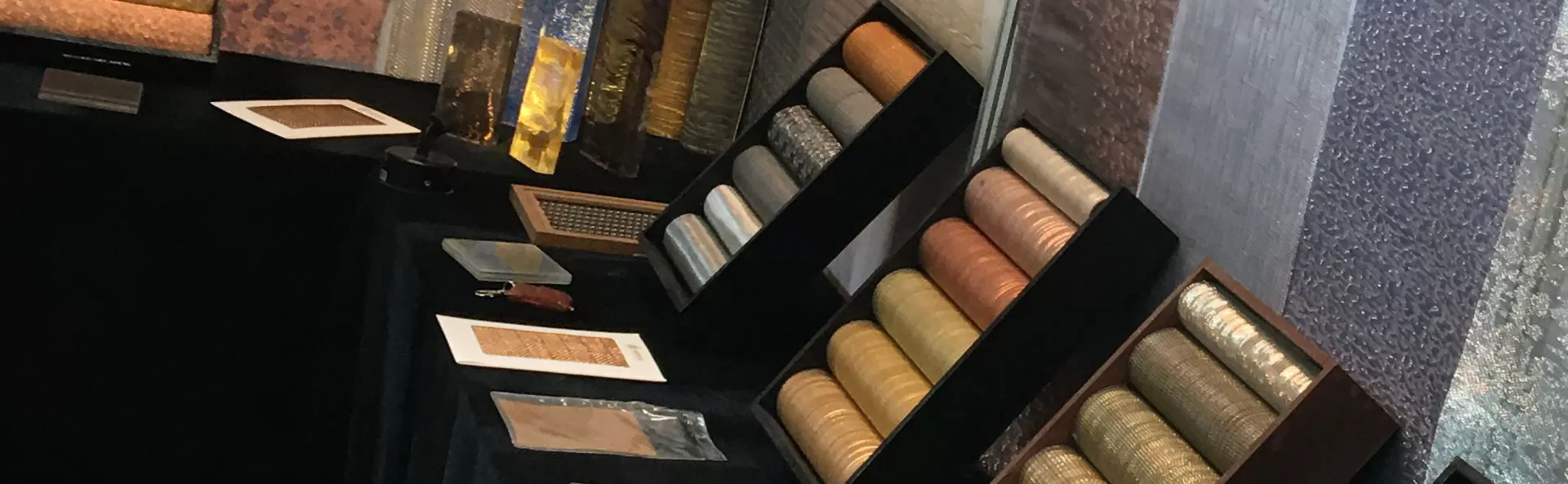
Woven metal fabric is available in many configurations.
Designers can choose:
Material
Stainless steel
Aluminum
Brass
Copper
Weave
Open weave
Dense weave
Decorative weave
Crimped structure
Custom patterns
Finish
Natural metal
Polished
Brushed
Colored
Coated
This gives designers considerable freedom to develop a unique interior concept.
How Woven Metal Fabric Is Used in Modern Interiors
1. Room Dividers
Room division is one of the most practical applications.
Instead of constructing a permanent wall, a designer can install woven metal fabric as a movable or fixed partition.
It can divide:
Restaurant seating
Hotel lobbies
Office areas
Retail spaces
Exhibition areas
The advantage is that the space remains visually open.
2. Hotel Lobby Decoration
Hotels are particularly suitable environments for woven metal fabric.
The material can be used around:
Reception desks
Lounge areas
Elevators
Corridors
Restaurants
Event spaces
Gold, brass, bronze, and stainless steel finishes can create different design styles.
A dense gold-colored mesh can create a luxury atmosphere, while a fine stainless steel mesh can create a more minimalist appearance.
3. Restaurant Interiors
Restaurants often need to separate seating areas while maintaining a sense of openness.
Woven metal fabric can be installed between tables or dining zones.
It can provide:
Partial privacy + Visual connection + Decorative texture
This is often more attractive than a conventional solid partition.
4. Retail Stores
Retail designers can use metal fabric to create:
Display backgrounds
Feature walls
Store partitions
Window decoration
Product display structures
Metallic reflections can also work together with store lighting to attract attention to selected products.
5. Elevator Interiors
Elevators are relatively small spaces, so material selection has a major visual impact.
Woven metal fabric can be used as a decorative layer on:
Elevator walls
Doors
Ceiling features
Decorative panels
The mesh adds texture without making the space appear completely enclosed.
6. Ceiling Decoration
Metal fabric can also be suspended from ceilings.
It can be installed as:
Flat panels
Curved elements
Hanging curtains
Decorative layers
When combined with lighting, the mesh can create a floating architectural effect.
7. Stairway Decoration
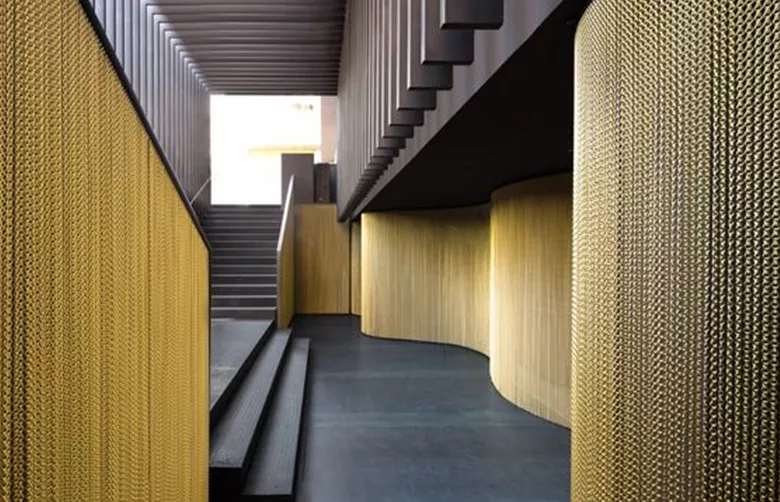
Woven metal fabric can be used around stairways as a decorative screen or spatial divider.
Possible applications include:
Stair screens
Decorative balustrades
Vertical partitions
Feature walls
The open structure can preserve visual connections between different floors.
8. Reception Areas
A reception area is often one of the first spaces visitors see.
A woven metal backdrop can create a distinctive brand environment.
Designers can combine:
Metal mesh + Logo + Lighting + Background wall
to create a customized reception feature.
9. Exhibition and Event Spaces
Woven metal fabric is also suitable for temporary installations.
It can be used for:
Exhibition booths
Stage backgrounds
Product displays
Event partitions
Decorative entrances
Its flexibility makes it easier to create unusual shapes than rigid metal panels.
Woven Metal Fabric and Lighting
Lighting deserves special attention because it can dramatically change the final appearance.
Backlighting
Place lighting behind the mesh.
This emphasizes:
Mesh patterns
Transparency
Shadows
Front Lighting
Lighting from the front highlights the metallic surface.
This is useful when the designer wants to emphasize:
Texture
Reflection
Material quality
Side Lighting
Side lighting can emphasize the three-dimensional characteristics of the weave.
It can create stronger shadows and depth.
How Different Metals Change the Interior
Stainless Steel
Stainless steel creates a:
Modern + Clean + Technical
appearance.
It is suitable for:
Contemporary interiors
Commercial buildings
Elevators
Public spaces
Aluminum
Aluminum is lightweight and available in many colors and finishes.
It is suitable for:
Decorative partitions
Retail interiors
Exhibition spaces
Ceiling decoration
Brass
Brass provides a warm golden appearance.
It works particularly well in:
Hotels
Luxury restaurants
Retail stores
High-end residential interiors
Copper
Copper creates a distinctive warm metallic appearance.
It can be used as a strong visual accent in:
Feature walls
Restaurants
Hotels
Cultural spaces
Woven Metal Fabric vs Traditional Fabric
Feature
Woven Metal Fabric
Traditional Fabric
Material Metal wire Textile
Appearance Metallic Soft
Durability High Depends on fabric
Transparency Adjustable Adjustable
Airflow Excellent Depends on weave
Light reflection High Low–moderate
Fire performance Metal-based Depends on textile
Texture Metallic Soft
Architectural applications Excellent Moderate
Cleaning Generally straightforward Material dependent
The two materials are not direct replacements for each other.
Woven metal fabric is particularly useful when the designer wants the appearance and flexibility of a curtain with the visual character of metal.
Woven Metal Fabric vs Solid Metal Panel
Feature
Woven Metal Fabric
Solid Metal Panel
Transparency Yes No
Airflow High Very low
Flexibility High Low
Weight Often lower Higher
Light transmission Yes No
Texture High Moderate
Draping Possible No
Room division Excellent Good
Visual layering Excellent Moderate
This is why woven metal fabric can be particularly effective in modern open-plan interiors.
How to Choose Woven Metal Fabric for an Interior Project?
1. Determine the Function
First decide whether the mesh will be used for:
Decoration
Room division
Privacy
Ceiling decoration
Wall decoration
Elevator interiors
Exhibition design
The function determines the appropriate mesh structure.
2. Choose the Transparency
The more open the mesh, the greater the:
Visibility
Light transmission
Airflow
A denser weave provides greater visual coverage.
Therefore, transparency should be considered early in the design process.
3. Choose the Metal
Consider:
Stainless steel for durability and modern appearance.
Aluminum for lightweight construction and color flexibility.
Brass for luxury interiors.
Copper for warm and distinctive aesthetics.
4. Choose the Surface Finish
Possible finishes include:
Natural
Polished
Brushed
Colored
Coated
Custom decorative finishes
The finish should be coordinated with:
Lighting
Flooring
Furniture
Wall materials
Brand identity
5. Consider the Installation Method
The installation system can include:
Curtain tracks
Rods
Frames
Cables
Hooks
Clamps
Tensioning systems
The installation method affects both appearance and functionality.
Why Designers Are Moving Toward More Flexible Materials
Modern interior architecture increasingly emphasizes:
Open spaces
Flexible layouts
Multi-functional areas
Visual connectivity
Natural light
Material contrast
Woven metal fabric fits naturally into this design philosophy.
Instead of creating permanent boundaries, designers can create soft architectural boundaries.
A metal curtain can separate two spaces today and be moved tomorrow.
This flexibility is especially valuable in commercial interiors where space requirements may change over time.
Common Design Mistakes
Using the Same Mesh Everywhere
A mesh that looks good on a feature wall may not be appropriate for a room divider.
Different applications require different:
Openness
Strength
Density
Installation methods
Ignoring Lighting
Metal mesh can look completely different under different lighting.
Always evaluate samples under the actual project lighting conditions where possible.
Choosing the Material Only by Color
A gold appearance does not necessarily mean the product is made from brass.
Different materials and surface treatments can produce similar colors.
Always confirm the actual:
Base material
Surface treatment
Finish
Corrosion requirements
Forgetting the Supporting System
A beautiful woven metal curtain still requires an appropriate installation system.
For large installations, designers should consider:
Weight
Span
Track capacity
Fixing points
Building structure
The Future of Woven Metal Fabric in Interior Design
The growing interest in woven metal fabric reflects a broader trend in architecture: materials are no longer expected to perform only one function.
A modern material may need to provide:
Decoration + Function + Flexibility + Sustainability + Spatial Experience
Woven metal fabric fits this trend particularly well.
It can be:
A curtain
A partition
A wall feature
A ceiling element
A decorative screen
A visual layer
A lighting surface
The same material can therefore serve different purposes within the same building.
Frequently Asked Questions
What is woven metal fabric?
Woven metal fabric is a flexible architectural material made by interweaving metal wires into different patterns. It is used for interior decoration, partitions, ceilings, facades, and other architectural applications.
Is woven metal fabric flexible?
Yes. Many woven metal fabrics are flexible enough to be suspended, curved, folded, or draped depending on their structure.
Can woven metal fabric be used as a room divider?
Yes. It is one of its most common interior applications because it provides separation while maintaining airflow and visual connection.
What metals can be used?
Common options include stainless steel, aluminum, brass, copper, and bronze.
Can woven metal fabric be colored?
Yes. Depending on the material and finishing process, different metallic colors and custom finishes can be produced.
Is woven metal fabric suitable for hotels and restaurants?
Yes. Its combination of decorative appearance, transparency, flexibility, and durability makes it particularly suitable for hospitality and commercial interiors.
Can it be used with lighting?
Yes. Backlighting, front lighting, and side lighting can all be used to emphasize the texture and transparency of woven metal fabric.
Why Choose Joinwin design Woven Metal Fabric?
Joinwin design supplies woven metal fabric for architects, interior designers, contractors, developers, hotels, restaurants, retailers, exhibition companies, and international distributors.
Available materials include:
Stainless steel
Aluminum
Brass
Copper
Bronze
Products can be customized according to:
Wire diameter
Mesh opening
Weave pattern
Mesh width
Mesh length
Transparency
Color
Surface finish
Curtain or panel configuration
Installation system
Typical applications include:
Interior Partitions + Hotel Interiors + Restaurants + Retail Stores + Elevators + Ceilings + Stairways + Feature Walls + Exhibition Spaces
For a project quotation, customers can provide the application, dimensions, preferred material, transparency, color/finish, installation method, quantity, and destination.
Conclusion
Woven metal fabric is changing modern interior design because it allows architects and designers to rethink the relationship between space, light, material, and separation.
Instead of a solid wall, designers can create a transparent layer.
Instead of a traditional curtain, they can introduce a metallic surface.
Instead of a static decorative panel, they can create a material that moves, reflects light, and changes appearance throughout the day.
Its greatest advantage is not simply that it looks different.
It is that woven metal fabric can combine:
Metal + Textile + Light + Transparency + Flexibility + Architecture
For modern interiors, that combination provides designers with a material that is both visually distinctive and functionally versatile.
Recommended News